Paddling puts you at eye level with the Southern Ocean's wildlife. Here is what you can realistically see off Cape Town and Hermanus, and when.
The cold, nutrient-rich water of the Benguela current and the warmer Agulhas water meeting around the Cape make this one of the richest coastlines on earth. On a surfski you sit low, quiet and slow, which is exactly why wildlife tolerates you. Nothing is guaranteed, but a season of paddling here delivers encounters most boat passengers never get.
Whales
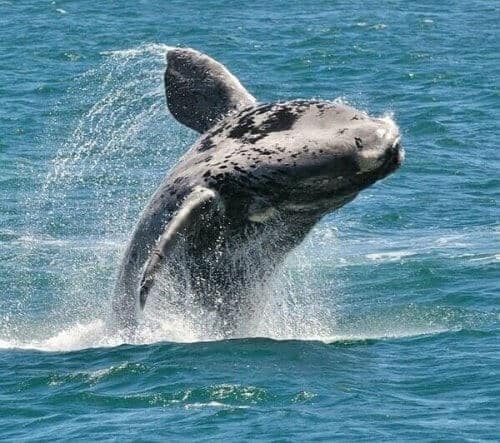
Southern right whale
The signature whale of the Western Cape. Southern rights migrate from Antarctic feeding grounds to calve and mate in the sheltered bays of the Cape coast between June and December, with the peak in September and October. Walker Bay at Hermanus is the best-known nursery in the world for the species; False Bay also holds good numbers. Look for a broad black back with no dorsal fin and a distinctive V-shaped blow.
Humpback whale
Humpbacks pass the Cape on their northbound migration around May to August and again heading south from about November to December, when large feeding groups sometimes gather off the West Coast. Long white pectoral fins, a knobbly head and dramatic breaching make them unmistakable.
Bryde's whale
The Cape's resident baleen whale, present in False Bay all year. Bryde's whales are sleek, fast, and often seen lunging through baitfish, frequently in company with dolphins, gannets and seals during sardine and anchovy activity.
Dolphins
Common dolphin
Travelling in pods of dozens to well over a thousand, common dolphins are the great spectacle of the South African coast. They move fast, often feeding under diving gannets, and will happily divert to inspect a paddler.
Bottlenose dolphin
Larger, greyer and more coastal, Indo-Pacific bottlenose dolphins cruise the surf line along False Bay, Walker Bay and the West Coast, frequently surfing waves right beside paddlers.
Cape fur seals
The most reliable encounter of all. Cape fur seals from the colonies at Duiker Island, Seal Island in False Bay and the Kommetjie coast are endlessly curious, corkscrewing under the ski and popping up beside your paddle. They are wild animals: enjoy them, do not feed or touch them.
African penguins
The endangered African penguin breeds at Boulders Beach in Simon's Town and at Stony Point in Betty's Bay. Paddling past Boulders you will see birds porpoising alongside the ski and rafting in small groups offshore — one of the highlights of our Penguin Paddle route. The species is under severe pressure, so keep your distance and never come between a bird and the shore.
Ocean sunfish
Mola mola, the ocean sunfish, is a regular summer visitor to False Bay and the Atlantic seaboard. You often find one basking on its side at the surface, a huge grey disc that looks like a floating dustbin lid until a fin flicks. Approach slowly and it will usually tolerate a close, quiet pass.
Seabirds
- Cape cormorant — endemic to southern Africa, seen in long low-flying rafts of thousands.
- Cape gannet — the diving bird of the sardine and anchovy shoals; a gannet column means fish, and usually predators, below.
- Shearwaters — sooty and Cory's shearwaters shear low over the swell on long offshore paddles.
- Kelp gull, swift tern, African black oystercatcher and white-breasted cormorant along every rocky shoreline.
- Cape fur seal colonies and Peninsula cliffs also hold Bank cormorants and, offshore, occasional albatross in winter.
When and where to paddle for wildlife
- June to December: southern right whales in Walker Bay (Hermanus) and False Bay.
- Year-round: Bryde's whales, Cape fur seals, African penguins and dolphins in False Bay.
- Summer: sunfish, sardine and anchovy activity, big gannet and cormorant flocks.
- Winter and spring: humpback migration and dramatic seabird passage on the West Coast.
If you would rather watch whales from a permitted boat than a ski, our Hermanus and Gansbaai whale watching trips run through the season and pair perfectly with a morning paddle.
Frequently asked questions
Marine Wildlife You May See While Surfskiing — FAQs
Keep reading