Surfski is South Africa's home-grown ocean sport. Here is what the boat is, how hard it actually is, and exactly what happens on a first guided session.
Surfski paddling grew up on South Africa's coastline, out of the surf lifesaving clubs of Durban and the Cape, and it remains one of the best ways to experience the ocean here. You sit on top of the boat rather than inside it, you steer with your feet, and on a good day the swell does much of the work for you.
What is a surfski?
A surfski is a sit-on-top ocean kayak, typically 5.8 to 6.5 metres long and remarkably narrow. Its defining features are a self-bailing footwell that drains water automatically as you move, a foot-operated rudder, and an open cockpit you can step off and remount in deep water. Racing skis are narrow and fast; beginner skis are wider, more forgiving and only marginally slower for a first-timer.
How fit do you need to be?
Less than most people assume. A guided beginner paddle covers 5 to 8km at a conversational pace over about two hours. If you can swim confidently and are comfortable with moderate exercise, you will manage. Good technique comes from the torso and legs, not the arms, so raw upper-body strength matters far less than a relaxed, rotating stroke.
Stability: the honest answer
A surfski feels tippy for the first fifteen minutes and then stops feeling tippy. That is the pattern for almost everyone. On a beginner ski in sheltered water, most people are paddling comfortably within half an hour. You will probably fall in at least once, which is why the very first thing your guide teaches is the remount: pull yourself across the boat, swing a leg over, sit up, carry on.
Safety basics
- Wear a personal flotation device and use an ankle leash so the ski cannot blow away from you.
- Never paddle offshore in an offshore wind as a beginner — it is far harder to come back than to go out.
- Paddle with others, and carry a phone in a waterproof pouch or a VHF radio on longer runs.
- Learn the remount before you need it, in shallow water, on your first session.
- Water temperature in Cape Town ranges from about 10 to 14°C on the Atlantic side and 14 to 20°C in False Bay — dress for immersion, not for the air temperature.
Equipment
- Beginner-width surfski, correctly sized paddle and adjustable footplate — all supplied on guided sessions.
- Personal flotation device and leash.
- Rashvest and boardshorts in summer; a paddling top or spring wetsuit in winter.
- Sunglasses on a retainer, high-SPF sunscreen and a cap.
- A hydration bladder for anything over an hour.
Reading ocean conditions
Cape Town's south-easter builds through summer afternoons and creates the famous downwind runs across False Bay; the north-wester of winter brings bigger, messier seas. Beginners paddle in the mornings, in sheltered water — Simon's Town to Boulders, Fish Hoek's corner of False Bay, Langebaan's lagoon or Walker Bay in Hermanus — where wind and swell are manageable.
What to expect on your first lesson
- 1Beach briefing: boat setup, footplate adjustment, paddle sizing, leash and PFD.
- 2Remount practice in waist-deep water until it is automatic.
- 3Flat-water technique: posture, torso rotation, foot steering.
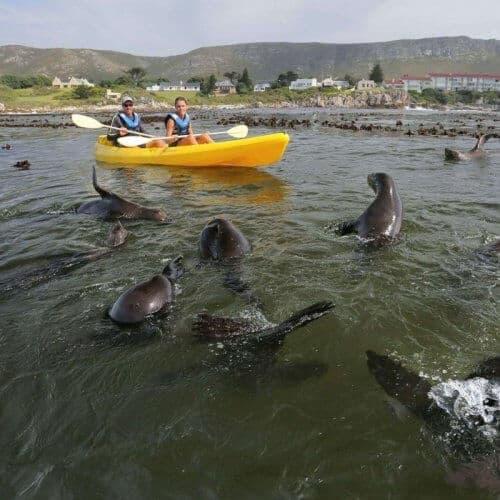
- 4A guided coastal paddle of 5 to 8km with stops for wildlife and photos.
- 5Debrief and, if you are hooked, a plan for progressing to your first downwind run.
Guided tours in South Africa
Our paddles run from Simon's Town, Fish Hoek, Kommetjie, Langebaan and Hermanus, with all equipment included and local guides. First-time paddlers can start on sheltered routes. Miller's Run Surfski Experience offers assessed guide-assisted doubles for suitable fit, active swimmers without necessarily requiring previous downwind experience; single-surfski participation requires appropriate ocean competence and remounting ability.
Frequently asked questions
Beginner's Guide to Surfski Paddling — FAQs
Keep reading
Related guides
Cape Town Surfski Adventures
Guided downwind runs, flat-water paddles and coastal expeditions.
Read guideHermanus Whale Watching
Southern right whales in Walker Bay from June to December.
Read guideSea Kayaking Hermanus
Walker Bay paddling for those who prefer a stable double kayak.
Read guideCape Town Hiking Tours
Table Mountain and Peninsula trails on your non-paddling days.
Read guide